How to Write an Anniversary Letter: 3 Complete Examples
Write a personal anniversary letter with three complete examples, a short note and a worked example of turning a real memory into a message.

An anniversary letter needs one true memory, what that memory means to you, and something you want your partner to hear now. Start with an ordinary moment you can picture. You don't have to summarise the whole relationship or sound like someone who writes love letters for a living.
This guide helps you finish the letter itself. The three original examples below have different purposes: thanking a partner for everyday care, marking a year of change, and celebrating an anniversary while apart. Use the structure that fits your relationship and replace the imagined details with your own.
Jump to: A simple letter shape · A letter of appreciation · A letter about this year · A letter across distance · A worked rewrite · Finish and give it.
Give your letter three parts
- Begin with a scene: where were you, what happened, and what did your partner actually do? “I keep thinking about the evening…” is enough to start.
- Say why it stayed with you: explain what you noticed or appreciated. Keep the explanation close to the scene, rather than adding a list of grand compliments.
- End in the present: say what you value now, or name one small thing you would like to share next. Choose something you mean, rather than a promise that sounds impressive.
Write the way you normally speak to them. A nickname, a familiar turn of phrase or a small shared joke may belong in the letter; formal wording may not. Hallmark's anniversary-writing guidance also distinguishes messages for your own partner from wishes you give to another couple. This guide is for the first of those.
1. When you want to thank them for ordinary care
This letter is for the things that can become so familiar you stop naming them. Choose an action your partner would recognise, and explain what it gave you. It doesn't have to be a dramatic rescue or a sacrifice.
Original illustrative letter: “I notice the small things”
The people and memories in this example are invented. It is a complete example of the form, not a customer letter or a story to borrow.
Dear Jamie,
I keep thinking about the evening my train was cancelled and you met me outside the station with that enormous red umbrella. You were holding it the wrong way round in the wind, and we laughed the whole walk home. It wasn't a grand occasion. It was a wet Tuesday, and you had decided I shouldn't have to finish it alone.
There are lots of small moments like that in our life. You save the last good peach because you know I'll look for it. You move the lamp closer when I'm reading. You remember which stories I want to tell twice and somehow still ask what happened next.
I don't want our anniversary to pass without telling you that I notice. The care you put into ordinary days makes them feel like days we belong in together.
I love the adventures we've had, but I love coming home with you just as much. This weekend, I'd like to take our familiar walk, stop at the bakery and leave the afternoon unplanned. Nothing elaborate. Just time to be glad we're here.
Happy anniversary. I'm grateful for you, and for this life we're making one ordinary day at a time.
Love,
Alex
Make it yours: keep one scene and one or two details. If your partner doesn't enjoy being praised for practical care, choose a different quality you appreciate: their curiosity, playfulness, honesty or the way you enjoy a shared interest.
2. When you want to mark what changed this year
An anniversary can be a chance to notice a particular chapter. A move, a new routine or a shared project may give the letter its shape. The change can be small; you don't need to invent a major milestone.
Original illustrative letter: “Look at what became ours”
This example imagines a couple making a new home together. Use it only as a writing structure if that isn't your experience.
Dear Morgan,
When I think about this year, I don't start with the moving van. I start with us eating noodles on the floor because we'd unpacked the bowls but couldn't find the table legs. You drew a map on the back of a receipt showing where you thought every box had gone. It was wildly inaccurate, and we kept it anyway.
At first, the place felt like somewhere we'd borrowed. Then there was the shelf we put up together, the neighbour we learned to wave to, and the spot by the window where you started keeping your sketchbook. Slowly, it became our place.
I learned things about you this year that I hadn't expected. You care about getting the small details right, but you can laugh when the plan goes sideways. You make space for what matters to me, and you tell me plainly what matters to you. I like that we are still learning how to do this together.
For our anniversary, I want to say thank you for the part you played in this chapter. I don't know every detail of the next one. I do know I'd like more walks around our neighbourhood, more meals at the table we finally assembled, and more chances to hear what you're thinking.
Happy anniversary. I'm glad this year was ours.
Love,
Sam
Make it yours: name what happened, one thing you learned about your partner, and what you want to carry forward. If the year was mixed, you can acknowledge that plainly. You don't have to call every part wonderful, and the letter doesn't have to resolve a conversation you still need to have.
3. When you are celebrating from different places
A letter across distance can recognise the relationship you are maintaining now. Keep future plans tied to what you've actually agreed. The letter can offer closeness without setting a deadline for a reunion or asking your partner to prove how much they miss you.
Original illustrative letter: “You are part of my ordinary day”
This example imagines two partners living in different cities. The ritual and memories are illustrative.
Dear Lee,
Happy anniversary. I wish we were at the same table tonight, but I wanted these words to reach you before our call.
I didn't expect your photographs of the street outside your flat to become one of my favourite parts of the week. At first I just wanted to see where you were. Now I know the shop with the crooked sign and the dog that seems to supervise the crossing. Your everyday world has become familiar to me, even from here.
I love the ways we keep each other in the ordinary parts of life: your message after the early shift, the films we pause while one of us makes tea, and the voice note you sent when I finally finished that difficult project. None of those things makes the distance disappear. They remind me that we are still making a relationship inside it.
Thank you for being honest with me about the good days and the difficult ones. I want us to keep choosing routines that work for both of us, rather than measuring love by how long we stay on the phone.
Tonight, let's share the meal we planned and tell each other one thing from this year we want to remember. I'm glad we're us, even with two tables between us.
With love,
Rory
Make it yours: use a real routine and one recent moment. If a call isn't possible on the day, the letter can stand on its own. You can agree another time to celebrate without making that a test of the relationship.
A worked rewrite: turn praise into a real detail
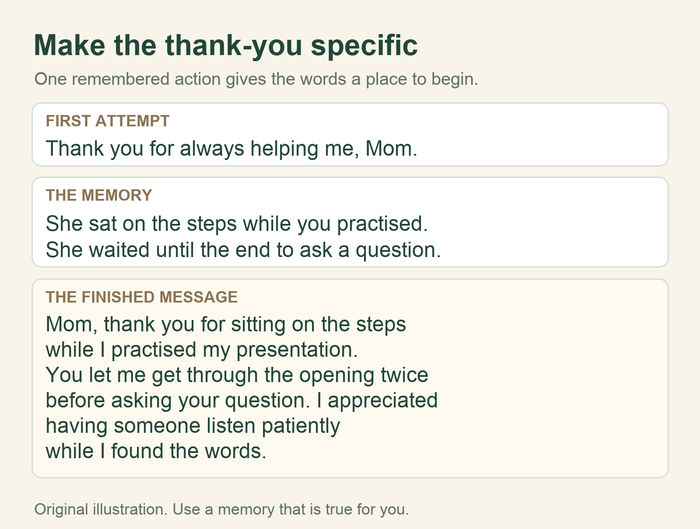
You don't need more impressive words. You need a detail that tells your partner what you mean. Here is an original illustrative example; it describes an imagined event.
First attempt
You are always supportive, and you make every day better. Thank you for being amazing.
What's missing: the reader can't see which moment you are thanking them for.
Revised version
When I was nervous before the interview, you walked to the corner with me and let me practise my opening answer one more time. You didn't tell me to stop worrying; you stayed beside me while I found my words. I felt less alone.
What changed: a witnessed action explains what “supportive” means in this relationship.
For your own letter, think of a moment you genuinely remember. Describe what happened before adding what it meant. If you don't know the exact day, you can say “the morning of the interview” rather than guessing a date.
Finish the letter, then choose how to give it
- Read it once in your normal voice. Change words you would never say to them. A plain sentence can carry a specific memory.
- Check the details. Keep the name, place and event accurate. A memory can be yours without needing to be a perfect chronology.
- Keep the strongest scene. If the letter turns into a list, save some memories for another time. The example doesn't need every holiday, home or anniversary in it.
- Choose a comfortable moment. Give it privately, place it with a gift, or send it when they have time to read. You don't have to watch their first reaction.
A shorter note is a finished letter too
If a full page isn't your style, keep the same three parts. This original example uses an imagined ordinary moment:
Happy anniversary. I still smile about the night we missed the last bus and walked home making up names for every dog we saw. I love how easy it is to enjoy an ordinary hour with you. I'd like another walk this weekend, with no missed bus required. I'm glad we're us.
If you want the same story in a song
The letter is already a complete anniversary gift. If your partner enjoys a musical keepsake, one scene and the message behind it can also become the starting point for a personal song. Use your real details rather than the imagined scenes in these examples.
Start a personal anniversary song, add the story and recipient in the Songbond song quiz, and review the current options. Keep the message you want to give at the centre, whichever format you choose.
Common questions
How do I start an anniversary letter?
Begin with a memory you can picture: “I keep thinking about…” or “When I look back at this year…” Then describe the real moment. You can add a greeting you already use with your partner; it doesn't have to be formal.
How long should an anniversary letter be?
Long enough to say what you mean, and no longer than you want to write. A few complete paragraphs can work. A short note with one real memory and a clear message is also finished; you don't need to match the length of the examples.
Can I use an example exactly as it is?
The examples show a shape you can use. Their names and memories are invented, so replace those with true details and your own words. Keep a sentence only if it is something you honestly want to say.
What if I don't usually write romantic messages?
Write one thing you noticed, one thing you appreciate and one thing you enjoy sharing. A letter can be affectionate, funny or straightforward. You don't have to use a style your partner would find unfamiliar.
Still choosing a gift? Anniversary gifts for a husband · Anniversary gifts for a wife · Long-distance anniversary gifts.