Thank You Messages for Mom: Specific Words and Two Complete Letters
Six original thank-you messages, two completed letters and a specific-memory edit help an adult child write to their mother in their own voice.

A good thank-you message for Mom names something she actually did and says what it meant to you. You do not need to wait for her birthday or Mother’s Day. A few honest sentences can stand on their own: “Mom, thank you for coming with me to collect the keys. I was nervous about that first afternoon, and your company made it less lonely. I’m glad we got to see the new place together.”
The examples below are original illustrative wording, not customer stories. Change the memories, names and details to ones that are true for you. Use Mom, Mum, Mama or the name you normally call her; the message should sound like your relationship.
Choose the thing you want to thank her for
Start with an action you can picture. What did she do, what did you notice, and what do you want to acknowledge now? A small event is enough. You can thank her for listening during a phone call without making claims about your whole childhood.
Keep these three parts in mind:
- The action: “You sat with me while I practised the presentation.”
- What it meant: “You gave me time to get through it without taking over.”
- Your thanks: “I appreciated your patience more than I said then.”
If you are stuck on “thank you for everything,” choose one moment instead. It gives you somewhere to begin, and you can decide later whether a short text or a longer letter suits it.
Six complete thank-you messages for Mom
A short letter about one recent kindness
Here is a complete original letter from an illustrative adult child, Nia, to her mother. It stays with one event instead of trying to sum up a lifetime.
The afternoon with the keys
Mom,
Thank you for coming with me to collect the keys to the flat. I know it looked like a simple errand, but that first afternoon felt bigger to me than I had expected.
You stood in the empty room with me, helped me find the light switches and laughed when we realised neither of us had brought a mug for the tea. I remember you asking where I wanted the chair, rather than telling me where it should go. That small question made the place feel like a choice I was allowed to make.
I appreciated your company and the way you gave me room to work things out. When I sit by the window now, I think of us there with the keys and the ridiculously large packet of biscuits.
I wanted to say thank you properly. I’m glad that first memory of the place includes you.
Love,
Nia
You can give a letter like this by itself. If it accompanies a housewarming photograph or another gift, let the letter explain the real shared moment; it does not need to explain the price of the present.
A longer letter about something you understand differently now
This second original illustration is from Rory, an adult child looking back at how their mother made space for them. The letter includes the relationship they share now, not only a list of past sacrifices.
The chair beside your worktable
Mom,
I have been thinking about the chair beside your worktable. When I was younger, I would sit there and tell you about whatever had happened that day. You would keep working on your drawings, then stop and look at me when I got to the part that mattered.
At the time, I mostly noticed that you were there. Now I notice the way you made room for me without making me feel that every conversation had to be important. I could bring you a bad joke, a question I was embarrassed to ask, or a story that took far too long to get to the point.
Thank you for that space. I am grateful for the time you gave me and for letting me hear about your own ideas too. I still like the conversations where we both arrive with something to show each other.
I loved seeing the drawings you brought on your last visit. Next time we meet, I would like to hear more about the one you started afterwards. I don’t want every conversation between us to be only an update on my life.
This is a small thank-you for the chair, the attention and the ordinary afternoons I understand better now.
With love,
Rory
Use a real scene of your own. Do not add a childhood memory because it sounds moving if it did not happen, and do not make a letter about understanding the past into a demand that she discuss it.
Turn a general thank-you into a message she can recognise
First attempt: “Thank you for always helping me, Mom. You’re the best.”
What the writer remembers: before a presentation, Mom sat on the steps while the writer practised the opening twice. She waited until the end to ask a question.
The finished message:
Mom, thank you for sitting on the steps while I practised my presentation. You let me get through the opening twice before asking your question. I appreciated having someone listen patiently while I found the words.
What changed: the thanks now names an action and the way it helped. The writer has not turned one afternoon into “you have always supported every choice I’ve made.”
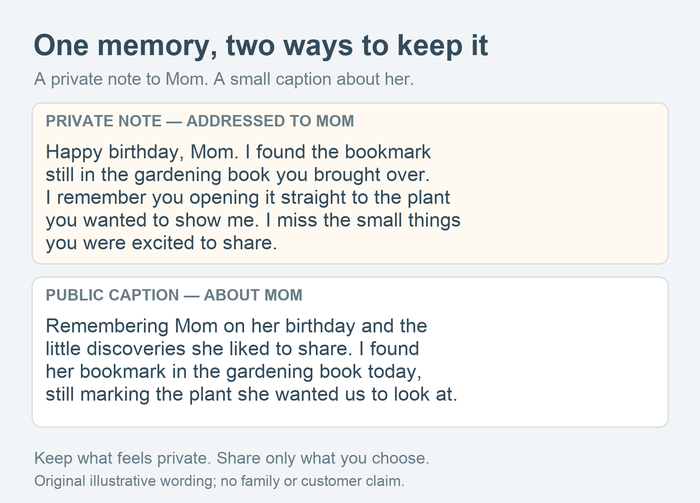
This is an illustrative edit, not a memory you need to borrow. Try the same move with one event you can describe truthfully.
If the relationship is complicated, keep the thanks bounded
You can appreciate one action without suggesting that everything between you is settled. Use a short message when a long letter would say more than you mean.
Thank you for checking in before my appointment, Mom. I appreciated you remembering the date and asking how it went.
You do not have to add “you’ve always been there” or a promise about the future. Choose words you are comfortable sending, and keep a private letter private if sharing it does not feel right for you.
Choose how to give the message
- A text: send the short version as it is. It can be a complete thank-you without a gift or a call attached.
- A card: write the message, sign it in your usual way and let her read it in her own time. You can enclose it with a photograph from the real event.
- A letter: give the longer version privately. You do not need an audience, a filmed reaction or a request that she read it aloud.
- Your voice: record the message if she would like hearing you say it. Our voice-recording gift guide explains that practical option.
If you are still choosing a present, the meaningful gifts for Mom guide covers that separate decision. The thanks you have written already stands on its own.
If you want the memory in a personal song too
A finished message can also be a starting point for a story song when that format suits your mother. Keep the giver’s voice clear: this is a message from her adult child to her, about the details you actually share. You do not need to write lyrics.
For the worktable example, the story could centre on that chair, the drawings and how your conversations have changed. Our guide to what to put in a personalized song helps you choose the details. If you want a newly created recording, start a personal song in the Songbond quiz and enter the order information there.
Choose the song because she would enjoy that kind of gift. A specific, honest thank-you message is already a finished way to acknowledge her.