How to Dedicate a Song: Messages and Giving Plans
Dedicate a song with four original example messages, private and group giving plans, and a clear way to share the recording.

To dedicate a song, choose the recording you want someone to hear, explain why you chose it and give them a clear way to listen. A short message can carry the personal part: a remembered moment, a thank-you or the reason this particular song belongs with them.
You can send it privately, listen together or introduce it at a gathering. Below are four complete original dedication examples and two finished handover plans. Use the format that suits your relationship, then replace the invented details with your own.
Choose the moment as well as the song
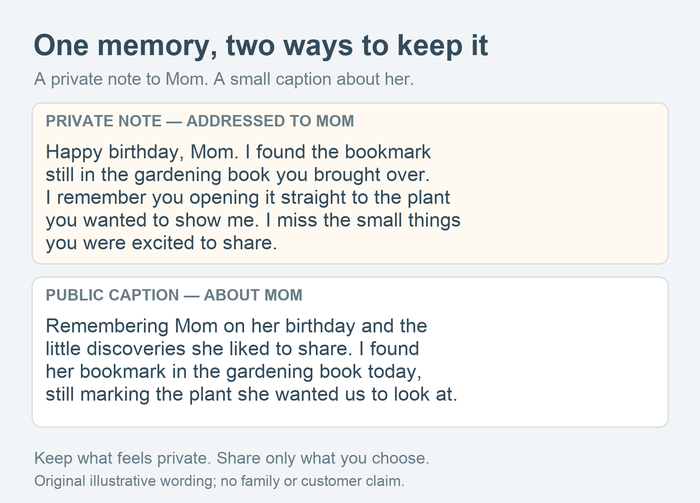
A surprise can be the choice of song or the words you wrote. If an audience would be unwelcome, keep the first listen private. You can give a dedication without making a recording of the person's response.
Decide what you are giving
A familiar recording can bring back a shared day, journey or routine. Your note explains the connection. Keep the artist's title and credit clear; dedicating their recording does not make it a song you wrote.
An original personal song can put your own memories into the words. Introduce it with the message you wanted to give and who it is from. If a service or another musician created it, describe that honestly: “I had a song made for you” is a clear introduction.
For either kind, check the particular version you have chosen. A live performance, cover or edited recording may have different words or a different ending. Read the lyrics in context and consider whether the singer's perspective fits your message. A romantic chorus can come with verses about a situation you do not mean to describe.
Four complete song dedication messages
These are original illustrative messages. The names, memories and recordings described are invented; they are not customer stories or recommendations for specific tracks. Each example has a different job.
1. Send a familiar song with a shared memory
Jo, this came on while I was unpacking and took me back to the evening we sat on your kitchen floor eating chips. You had brought the spare plates, but the company was what made the new place feel less strange. I chose this song for that memory. Thank you for helping me settle in. Here's the listening link for whenever you'd like it.
Casey
Make it yours: name the real moment connected to your chosen recording. Explain that connection in your own words, especially if you mean one memory rather than every line of the lyric.
2. Introduce an original song you had made
Ari, I had a song made about the summer we built those crooked shelves and the evenings you stayed to help me get the shop ready. I wanted to say thank you for the time, the ideas and the company. The song is from me. We can listen together after dinner, or I'll send it so you can hear it when you want.
Noor
Make it yours: identify the person giving it and the true details in the finished recording. Use “from all of us” only when the other givers have agreed to that message.
3. Give a short spoken dedication at a gathering
Before the next song, a quick thank-you to Lee from me. I chose this because it reminds me of the Saturday afternoons we spent fixing up the garden. Lee, thank you for turning up with tools and staying for tea. Sam has the recording ready; let's listen.
Make it yours: agree the moment with the host and playback person. Keep the personal detail suitable for this audience, then leave space for the song to begin.
4. Keep an ordinary music message small
This made me think of our Wednesday walks home. I thought you'd enjoy hearing it too. Sending it with a hello; we can compare favourite bits next time we meet.
Make it yours: a dedication can be friendly and light. It does not need an anniversary, a long declaration or a promised emotional reaction.
A finished private handover
In this invented example, Casey wants to send Jo the familiar recording connected to moving into the new place. The dedication is the personal note, and the listening link is the practical part.
- Choose the exact recording. Casey finds the intended artist and version, then uses the service's share feature. Casey checks that the link opens the correct track and notices any sign-in or subscription requirement.
- Put the reason before the link. Casey uses message one above, followed by the actual listening URL. That gives Jo a reason to open it without a long explanation to decode.
- Send through an existing channel. Casey uses the chat where they normally share music. There is no need for an extra account or a new gift website merely to carry the note.
- Let the gift arrive as one message. Jo can see who sent it, why the song was chosen and how to listen. Casey does not follow it with a demand to play it immediately.
If Jo cannot access the service, Casey can agree another legitimate listening route that Jo already uses. A share link does not remove the destination's access requirements. For a local recording you are allowed to share, explain the file and the way to open it rather than sending an unexplained attachment.
A finished listen-together handover
In this separate invented example, Noor is giving Ari the original song described in message two. They are already having dinner together.
- Have the finished recording ready. Noor opens the intended version and checks the playback device before the evening. The gift uses the actual recording, not a draft or an order screen.
- Offer a moment. After dinner, Noor says, “I've got a song for you about the summer we opened the shop. Would you like to hear it now?”
- Give the short introduction. If Ari says yes, Noor uses the central thank-you from message two and starts the recording. The introduction explains the gift without describing every lyric in advance.
- Finish with a way to keep listening. Noor sends the finished recipient listening link or agreed audio copy afterwards, with the title and the message. Ari can find it again without asking which version was meant.
If Ari would prefer another moment, Noor sends the note and agreed listening route. The gift can keep its meaning while the timing changes.
For a group, give the playback person a clear cue
Keep the introduction and the playback plan separate. Send the person handling music the exact recording, the agreed start point and a short cue. Here is a complete illustrative handover note:
Sam, Lee is happy for us to include one music moment after the thank-you. I'll introduce the song from my own perspective, then finish with “Sam has the recording ready; let's listen.” Please begin the version we've checked when I step back. After it ends, please hand back to Morgan for the next part of the evening.
Use the real people, recording and agreed order. If the venue has technical or music-use requirements, arrange those with the host. A casual private dedication and a public event can have different practical needs.
The dedication has three parts
Read the note once before you give it. Check the recipient's name, who the message is from and whether the words say what you mean. Keep the recording and its link with the finished note.
Want a song about your own memories?
If you want the recording itself to carry your story, start a personal Songbond song. Enter the recipient, real memories and preferences in the quiz, then review the current options. The dedication can remain a few plain words about why you chose to give it.
Questions about dedicating a song
What do I say before playing the song?
Name who it is for and give one reason you chose it. “This is for Lee, with thanks for the afternoons we spent in the garden” can be enough. At a gathering, agree the slot and playback cue in advance.
Can I dedicate a song without singing it?
Yes. A note with a listening link, a recorded track played together or a short introduction can all carry the dedication. If you want to perform live, choose a version you can prepare and a setting that welcomes it.
Does every lyric need to describe us?
A familiar song may matter because of a shared memory. Explain that connection, and check that its wider story will not contradict your message. An original personal song is an option when you want the words to use your actual details.
Should I post the dedication publicly?
Choose the audience with the recipient. A direct message is a complete dedication. If you both want to share it more widely, agree which personal details and recording link belong in that version.