Retirement Speech for a Coworker: 2 Complete Examples
Use two complete original coworker retirement speeches, choose the right speaker and turn real workplace memories into a short tribute.

A retirement speech for a coworker can be simple: say how you know them, tell one true workplace story, explain what it showed you about them and finish with a direct thank-you. You are giving them a few minutes of recognition, rather than trying to summarize their entire career.
Below are two complete original examples. One is for a teammate who knows the retiree well; the other is for a coordinator speaking on behalf of a team. Choose the role closest to yours and replace the example's details with things you can honestly say.
Decide whose voice the speech represents
If you are a close colleague, speak from your own experience. If you are representing a team, credit the memories people contributed rather than presenting all of them as things you personally witnessed.
Check the place of your speech in the gathering: before a gift, between other speakers or as the final toast. Ask the organizer how much time you have and whether someone will introduce you. For a short toast, Toastmasters recommends a focused two to three minutes. Use the time agreed for your event and rehearse your own version aloud.
These examples are spoken to the person retiring. They are not farewell speeches delivered by the retiree, and they are not for someone leaving to take another job.
Example 1: A close teammate at a retirement gathering
Invented example. Jamie has worked beside Alex for eight years and is speaking at a small team gathering. Every name, quotation and workplace scene in this speech is illustrative. Use your actual relationship and a story the retiree would be comfortable hearing in this room.
I'm Jamie, and I've worked alongside Alex for the past eight years.
Alex, when I was new here, I used to arrive at our planning meetings with a page full of questions and hope I would not have to ask all of them. At one of those first meetings, you stayed behind, pulled up a chair and said, “Let's take them one at a time.”
You did not just give me the answer. You explained how you had reached it. You were patient enough to explain the process twice, and generous enough to treat the second time as though it were the first.
That is what I want to thank you for today. You made it easier for people to learn here. When something was unclear, you asked the question other people were hesitating to ask. When someone had done good work, you made sure their name was attached to it.
I have enjoyed the ordinary parts of working with you too: the walk back from lunch, the book recommendations written on whatever paper was nearest, and the way a quick conversation could turn into a useful idea. Those moments are part of what I will miss about seeing you every day.
As you retire, I hope you enjoy having more choice about your time, whether that means a busy week or a quiet afternoon. You have given this team your experience and your attention, and we are grateful for both.
Alex, thank you for being such a thoughtful colleague. I am glad we got to work together. Please join me in wishing Alex a happy retirement.
The main story is a witnessed action, not a list of adjectives. The closing acknowledges retirement without inventing travel plans, hobbies or promises to keep working.
Example 2: A coordinator giving a short team thank-you
Invented example. Mina joined the team recently and is introducing a gift for Priya at a brief all-staff farewell. Mina has collected a few voluntary contributions. The people and contributions below are fictional; a real coordinator should use agreed, accurate wording.
I'm Mina. I have worked with Priya for the past year, so I asked some of the people who have been here longer what they would most like to thank her for.
The notes came back with small, useful stories. A handover that made a difficult week easier. Instructions clear enough for a new person to follow. A reminder to give someone credit for the work they had quietly done.
Priya, those stories helped me recognize something I have seen myself: you put care into the work and into the people doing it. The rest of us benefited from details that you took the time to get right.
We have brought those messages together in this book, so you can read them whenever you like. I hope it gives you a clear picture of the contribution your colleagues wanted to recognize.
Thank you for everything you have shared with the team. We wish you a happy retirement and time for the things you choose. Priya, this is from us, with our thanks.
If there is no message book, remove the gift paragraph and finish with the thank-you. The speech remains complete. If several people are speaking, this shorter role avoids repeating the whole career history.
Build your own version around one story
Choose the action first. Think of a time they explained something patiently, made a handover easier, supported a colleague or improved a shared routine. You do not need the biggest achievement of their career.
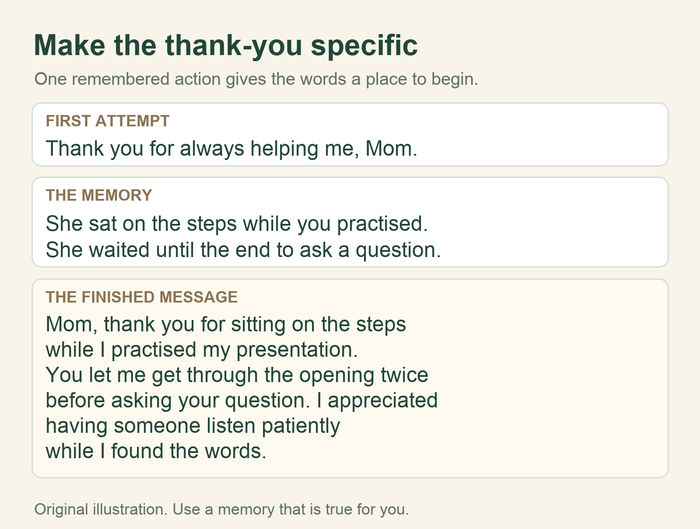
Then connect the action to its meaning. “You were always helpful” is broad. A more specific line might be: “You made a page of instructions for my first handover, then stayed while I tried it myself.” That gives the room something they can picture.
Give your speech five short parts:
- Your connection: who you are and how you worked together.
- The scene: one moment, explained plainly enough for the whole room.
- What it showed: why their action mattered to you or the team.
- The thank-you: say what you want them to know today.
- The finish: a wish for retirement, a toast or a clear gift handoff.
Verify any job titles, years of service or achievements you choose to mention. If you do not know those details, a personal account of working together is enough. Leave out private client information and stories that belong to someone else's confidence.
Ask the team for one useful memory
A coordinator does not need a contribution from every person. Invite participation, choose a few distinct details and make the attribution clear. Here is an illustrative collection message for the second speech:
I'm giving a short thank-you at Priya's retirement gathering on Friday. If you'd like to contribute, please send me one work memory or something you would like to thank her for by Wednesday. A few sentences are enough, and it's fine to skip it. Let me know whether I may read your words aloud with your name, or whether you would prefer them to stay in the message book.
Replace the days with the actual schedule. Use only contributions that suit the gathering, and confirm any quotation you intend to read. If several notes repeat the same idea, choose one representative scene rather than adding them all to the speech.
Keep the humor kind and easy to understand
A familiar, harmless habit can bring some warmth: the unusually neat labels, the reliable lunch recommendation or your own first-day confusion. Explain enough context for people who were not there.
Skip jokes about age, health, money or someone being glad to escape the team. A retirement gathering does not need a roast. Toastmasters' guidance on occasion humor recommends considering what might offend and checking uncertain material with someone beforehand. If a joke takes a long explanation or needs the retiree to defend themselves, use another detail.
Choose an opening and a clear ending
These original lines can help when you know the story but struggle to start or stop:
- Personal opening: “Before I thank you for the big things, I want to remember one ordinary afternoon that stayed with me.”
- Team opening: “A few of your colleagues sent memories for today. One theme came through in all of them: the care you put into the work.”
- Simple closing: “Thank you for being someone I was glad to work alongside. I wish you a retirement you can make your own.”
- Gift handoff: “These are the messages people wanted you to keep. Please read them whenever you feel like it.”
- Toast: “Please join me in wishing Sam a happy retirement.” Replace the illustrative name with the retiree's.
Choose a team opening only if it accurately describes the contributions you received. A toast can use any drink; if the setting has no glasses, a clear thank-you and applause works too.
Rehearse the handoff as well as the words
Read your speech aloud at a comfortable pace and time that version. Shorten repeated praise before cutting the story that makes it personal. Keep a readable copy or a few clear notes with you.
At the gathering, wait until people can hear you, say your introduction and pause after the main story. If you lose your place, look at your notes and continue. For a gift, decide who is holding it and when you will hand it over. For a song or slideshow, let the person controlling playback know exactly when your words finish.
You can give the retiree a copy afterwards, so the words remain a keepsake even if the room was busy. Recording the speech is optional; agree that with the people involved rather than making it part of the surprise.
Questions about coworker retirement speeches
What if I do not know the person very well?
Use the coordinator approach, or give a short thank-you based on what you have actually seen. You do not need to claim a close friendship. Invite accurate contributions if that fits your role, and credit them.
Should I list their whole career?
Only if that is your agreed role. When someone else is covering the formal career history, your contribution can be one story about working together. Avoid repeating the same facts across several speeches.
What if they prefer a quiet farewell?
Respect the format they have chosen. Put the words in a card or give a short private thank-you. An audience is not necessary for a retirement message to be worthwhile.
A keepsake after the thank-you
If the team wants to add an original song, the same accurate work memories can help give it a clear message. Keep the speech complete, then introduce the song as a separate gift. You can start the Songbond song questions, where you enter the recipient, memories and music preferences.
For other options, see retirement gifts for a coworker or music for the retirement gathering. A finished speech can be the whole thank-you, or one part of the send-off.